Brazil’s Great Ownership Transition: What Happens When Founders Retire?
As Brazil ages, a generation of founder-led companies is approaching a critical decision: sell, professionalize, merge, or pass control to the next generation.
Brazil’s next important M&A trend may not begin with a distressed balance sheet, a foreign buyer, or a private equity fund looking for a platform. It may begin with a founder asking a more personal question: what happens to the company when I no longer want, or am no longer able, to run it?
Over the past 30 to 50 years, Brazil produced a generation of entrepreneurs who built companies through extraordinary volatility. Many started, survived and expanded their businesses through inflation, stabilization plans, market opening, privatization, credit cycles, currency crises, commodity booms, recessions and technological change. Brazil’s 1990s were widely described as a reform period, while the Real Plan of 1994 marked the end of hyperinflation and created a more stable environment for business planning.
These entrepreneurs built companies in a Brazil that often rewarded resilience, personal relationships, instinct and control. In many cases, the founder became much more than the shareholder. He or she was the CEO, chief salesperson, credit officer, negotiator, risk manager, culture carrier and final decision maker. That model worked for decades. But as founders age, it creates a new strategic question: can the business remain valuable when the founder steps back? This is not a future issue. It has already begun.
Three things are converging at once. A large generation of founders is reaching the age where succession stops being a someday question. The traditional path, passing the business to the children, is proving less reliable than it used to be. In addition, growth itself has gotten harder to fund alone. For founders in the technology space, venture and growth capital in Brazil remain well below 2021 levels, with investors far more selective outside a few favored themes like artificial intelligence. A new tax law, meanwhile, increases the cost of delay for founders in every sector. Together, these are turning a demographic story into an M&A story.
Brazil is aging quickly. According to IBGE’s 2022 Census, the number of people aged 65 and over reached 22.2 million, or 10.9% of the population, up from 7.4% in 2010.1 The same Census showed that Brazil’s median age rose by six years, reaching 35 in 2022.1 This demographic shift is usually discussed in the context of pensions, healthcare and public finances. But it also has a less obvious consequence: a significant share of Brazil’s corporate ownership is about to change hands.
For M&A, the relevant universe is much smaller than Brazil’s headline number of companies suggests. Of Brazil’s roughly 22 million active businesses, by our own estimate, roughly 3.1 million sit beyond the micro and small company universe. For M&A, this is the more relevant pool: mid-to-large private companies, many of them founder-led, family-controlled and increasingly approaching succession decisions.
The companies built during Brazil’s stabilization era are entering their succession era Many of today’s privately held companies were shaped by the economic transformation that followed Brazil’s inflationary decades. Before the Real Plan, long-range business planning was extremely difficult. Brazil experienced repeated stabilization attempts before inflation was finally brought under control in 1994. After stabilization, companies could plan with greater visibility, access new forms of credit, participate in more sophisticated supply chains and serve a growing consumer market.
The 1990s and 2000s created opportunities across many sectors, including healthcare, education, agribusiness, logistics, industrial services, food and beverage, distribution, retail, financial services and technology-enabled business models. Some founders built local champions. Others created regional platforms. Some became national leaders in their niches.
But many of these businesses remain deeply founder dependent. Their value is real, but it may not yet be fully transferable.
That distinction matters in M&A. A company can be profitable and still not be ready to sell. Buyers do not only acquire historical earnings. They acquire confidence that those earnings can continue after a change in ownership. If customer relationships sit mainly with the founder, if decision making is informal, if financial reporting is not institutionalized, or if second-level management is weak, buyers may discount the business, delay the process, or walk away.
In other words: the founder may be ready to retire before the company is ready to be sold.
Why succession often becomes a transaction question The traditional assumption in many family businesses is that one of the children will eventually take over. But that assumption is becoming less reliable. Families are smaller. Heirs may have different careers, live abroad, prefer financial assets to operating responsibility, or disagree about risk, dividends, reinvestment and control.
Even when the next generation is capable, it may not want the same life the founder lived. At the same time, many sectors are becoming more competitive and more consolidated. Scale matters. Technology matters. Governance matters. Access to capital matters. Professional management matters.
A company that was perfectly viable as a founder-led business may need a different ownership structure to compete over the next decade.
There is also a new tax dimension to the timing question. Since the start of 2026, every Brazilian state has had to replace its flat inheritance and gift tax rate with a progressive one, within the existing 8% ceiling.2 In states that previously charged a single flat rate, such as São Paulo’s 4%, this change is expected to roughly double the tax bill on larger estates.2 For founders who assumed that passing the company to the next generation was the costless default option, that assumption just became more expensive.
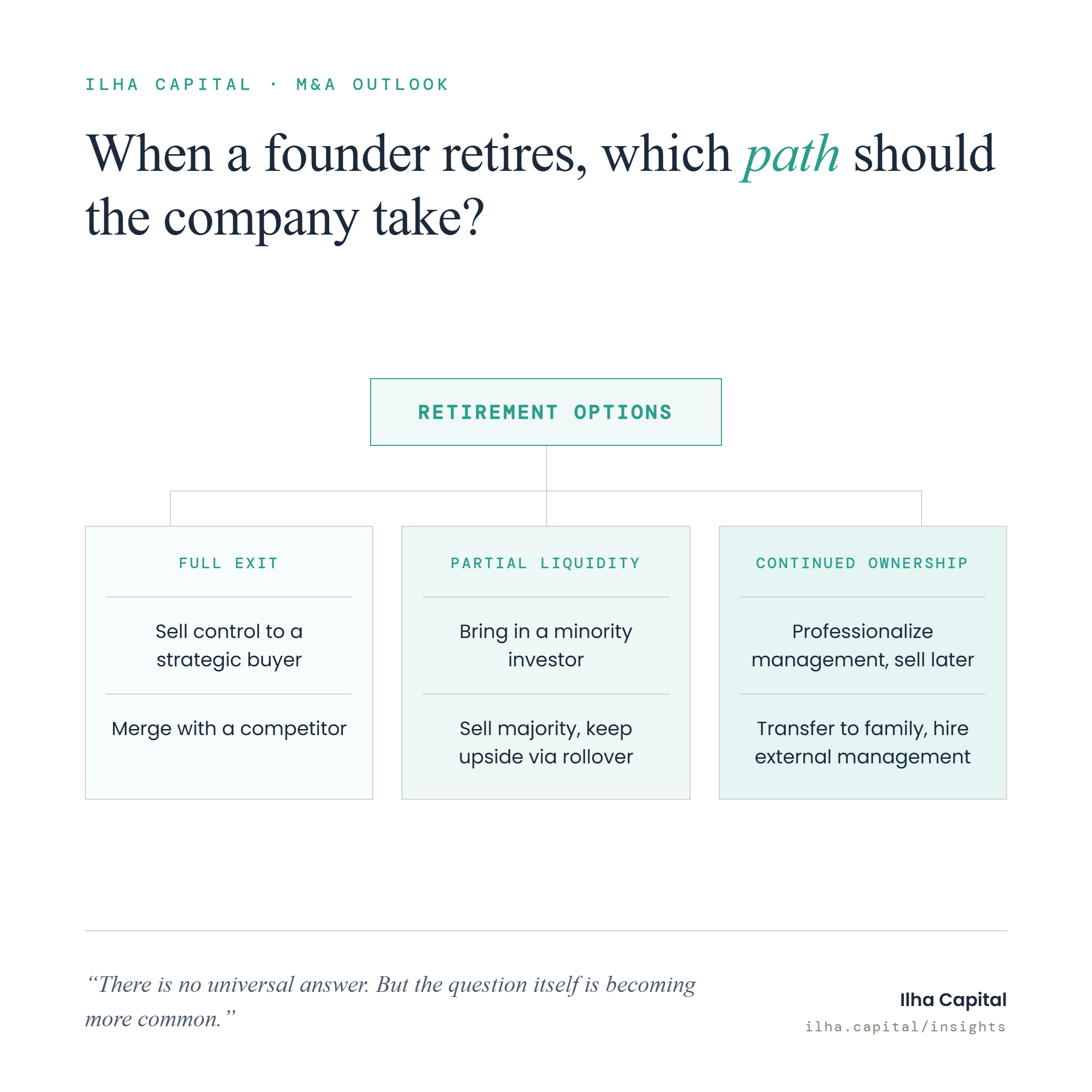
The founder may ask: should I sell control to a strategic buyer? Bring in a minority investor? Merge with a competitor? Sell a majority stake but retain upside through a rollover? Professionalize first and sell later? Or transfer ownership to the family while hiring external management?
There is no universal answer. But the question itself is becoming more common.
A trend already underway Brazil’s M&A market has remained active despite volatility, even as deal volume cooled slightly amid higher rates. Kroll reported 1,341 M&A transactions in Brazil in 2025, a 5.9% decrease compared with 2024, with activity concentrated in technology, financial services, energy, food and beverage and healthcare equipment and services.3 TTR Data reported 1,877 transactions worth a combined EUR 303.5 billion in Brazil in 2025, led by the internet, software and IT services sector, with the United States remaining Brazil’s most active cross-border counterparty, a pattern that has continued into 2026.4
Financing conditions add another layer. Brazil’s benchmark Selic rate stood at 14.25% in mid-2026, still historically high even after cuts from a 2026 peak of 15%, which keeps acquisition debt expensive and pushes many buyers toward earnouts, rollovers and seller financing rather than clean cash exits.5 The same rate differential has also kept the real firmer through 2025 and 2026, a reversal of the sharp devaluation seen in 2024, changing the calculus for foreign buyers evaluating Brazilian targets today.
Not every transaction is driven by succession. Many are driven by consolidation, capital needs, foreign investment, technology, regulation or strategic repositioning. But the conditions for succession-driven transactions are increasingly visible: aging founders, founder-led companies, fragmented sectors, active buyers and businesses that need professionalization to continue growing.
This is why Brazil’s ownership transition should not be seen as a sudden wave. Waves are temporary. This is more likely to be a long underlying current in Brazilian M&A. It will appear through a series of individual decisions: one founder sells after receiving an unsolicited approach; another brings in a minority investor; another merges with a competitor to solve scale and succession at the same time; another spends three years preparing the company for sale; another passes ownership to the family but hires external management.
Individually, these are private decisions. Collectively, they may become one of the most important structural forces in Brazilian M&A over the coming years.
What founders should understand before the decision becomes urgent For founders approaching retirement, the first step is not necessarily to start a sale process. In many cases, the first step is to understand the company’s strategic alternatives.
That means asking practical questions: who are the natural buyers or partners? Would a strategic buyer, financial investor, family office or competitor value the company differently? Is the company ready for due diligence? How dependent is the business on the founder? Are financial statements, tax matters, labor issues and contracts ready for investor review? Is there a credible management team beyond the founder? Would the family prefer a full exit, partial liquidity or continued ownership? Should the company professionalize before going to market?
The best M&A outcomes are rarely improvised. They are prepared for, often years in advance. A rushed transaction often gives the advantage to the buyer. Preparation buys a founder something real: the ability to control the timing, address what a buyer would otherwise flag, and negotiate without feeling cornered.
This is especially important because succession-related M&A is emotionally different from purely financial M&A. The company may represent the founder’s life’s work. It may employ relatives, long-standing employees and community members. It may carry the family name. Selling, merging or bringing in a partner is not only a capital decision. It is also a legacy decision.
A long transition, not a short cycle The founders who built businesses during Brazil’s stabilization and growth cycles are now entering a different phase. Their companies must eventually answer a basic question: who will own, govern and lead the business after the founder?
For some, the answer will be family succession. For others, it will be professionalization. For many, it will involve M&A: a full sale, minority investment, merger, strategic partnership or staged transition of control. The key point is that these outcomes should be designed, not forced.
By the time a transaction feels urgent, some of the best options have usually already closed. For founders thinking about the next chapter, this is rarely just a decision to sell. It’s about understanding the alternatives, getting the business ready, and choosing the path that protects what took decades to build.
Because in the end, the question is not only what the company is worth today. It is whether that value can survive, and perhaps grow, when the founder finally steps back.
Sources
- IBGE 2022 Demographic Census: people aged 65 and over reached 22.2 million (10.9% of the population), up from 7.4% in 2010; median age rose to 35. agenciadenoticias.ibge.gov.br ↗
- Complementary Law 227/2026 makes progressive ITCMD rates mandatory across Brazilian states, within the 8% ceiling set by the Senate; analysis of the changes and their effect on inheritances. machadomeyer.com.br ↗
- Kroll, Brazil Transactions Insights 2025: 2025 Brazilian M&A deal volume, by sector. kroll.com ↗
- TTR Data, Brazil Annual Report 2025: 1,877 transactions worth a combined EUR 303.5 billion, led by internet, software and IT services. ttrdata.com ↗
- Banco Central historical Selic series: rate at 14.25% in mid-2026, after cuts from the 15% peak. www.bcb.gov.br ↗