Defending Quality of Earnings
Why understanding QoE Analysis is essential for Brazilian founders looking towards an exit.
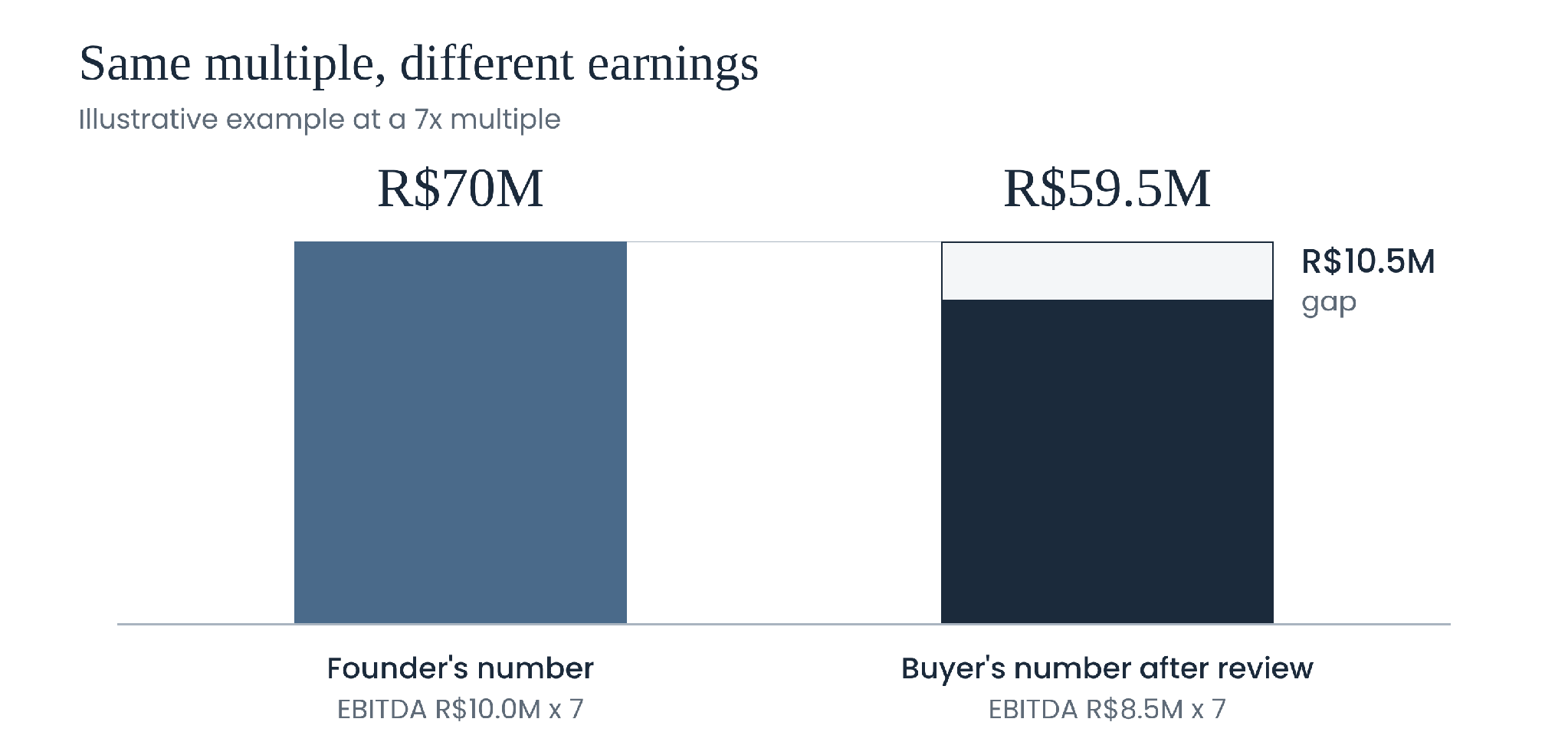
I’ve watched two sides agree on value early in a transaction discussion and then see very different numbers once the quality of earnings analysis came back. The agreement was on the multiple, and the earnings that multiple applies to hadn’t been tested yet.
If there is one thing I’d want a founder to take from this piece, it is that your EBITDA and a market multiple give you a number that is a fair place for a conversation to begin, while what a buyer will pay gets decided later, on the EBITDA it can verify, after it has looked at the working capital the business needs and at the debts that come with it, some of which never appear on the balance sheet.
Key Takeaways
- Your EBITDA times a market multiple is a fair place to start a conversation. The price a buyer will pay is settled later, on the EBITDA it can verify.
- A quality of earnings review tests how much of your reported profit will continue under a new owner, so a company with a clean audit can still see its EBITDA come down.
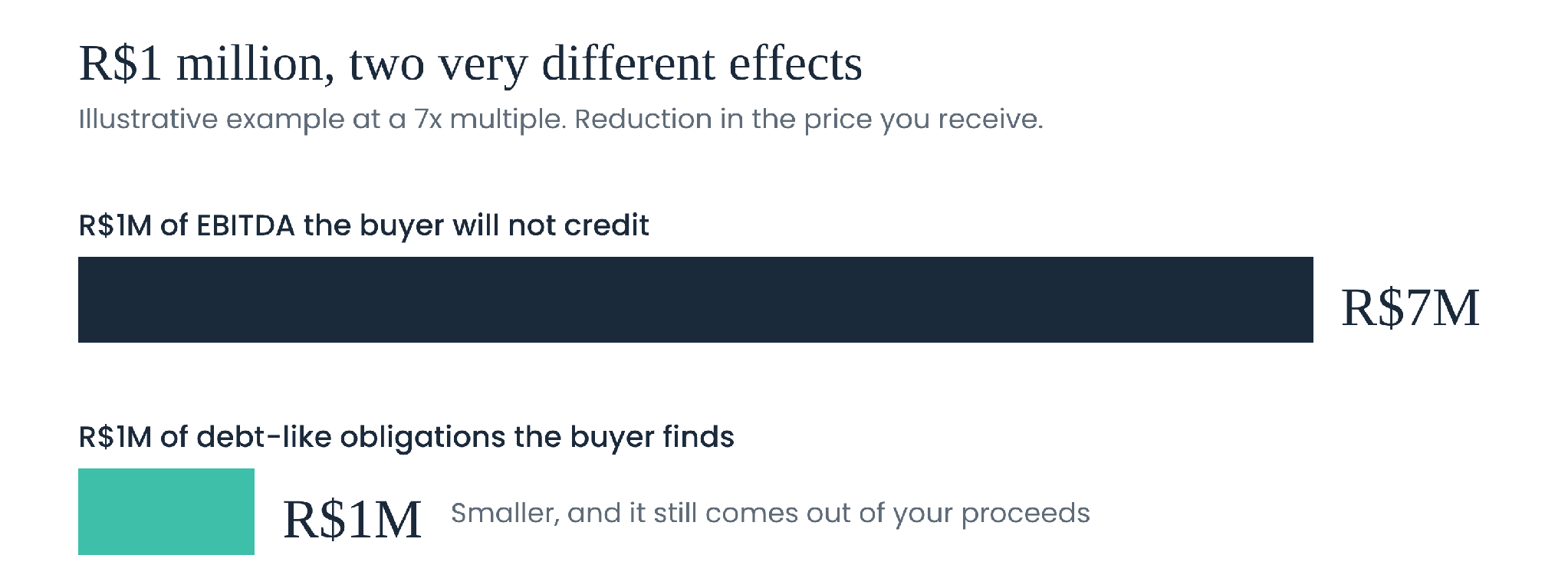
- An EBITDA adjustment is multiplied by the deal multiple, while debt-like items reduce the price one for one, and both come out of your proceeds.
- In Brazil, tax and labor exposure stays with the company, so a buyer will price it in even if it was never recorded.
- Building your own version of the buyer’s analysis before a process starts lets you decide which adjustments you can support before anyone else raises them.
What the review looks at
Buyers use a quality of earnings review, or QoE, to estimate how much of the profit a company reports will still be there once it has a new owner. The reviewer starts with reported EBITDA and works toward an adjusted figure. Some adjustments come from management, like a one-time cost or an owner expense that won’t continue, others are found by the reviewer, such as revenue booked in the wrong period or a cost that has been put off, and a third kind looks forward, like a new contract that hasn’t yet produced a year of revenue. A buyer gives full credit to what you can document from the past and discounts what rests on a promise about the future.
An audit gives an opinion on whether the statements follow the accounting rules, while a QoE gives no opinion and tests what the buyer is paying for, so a company with a clean audit can still watch its EBITDA come down in diligence.
Working capital, the cash the business needs to run day to day, and net debt, which in a deal includes obligations that never show up as loans, move the price in different ways from EBITDA. Suppose a buyer pays 7 times EBITDA. The same R$1 million moves the price by very different amounts, depending on whether it is EBITDA or debt.
Why this belongs in your exit planning
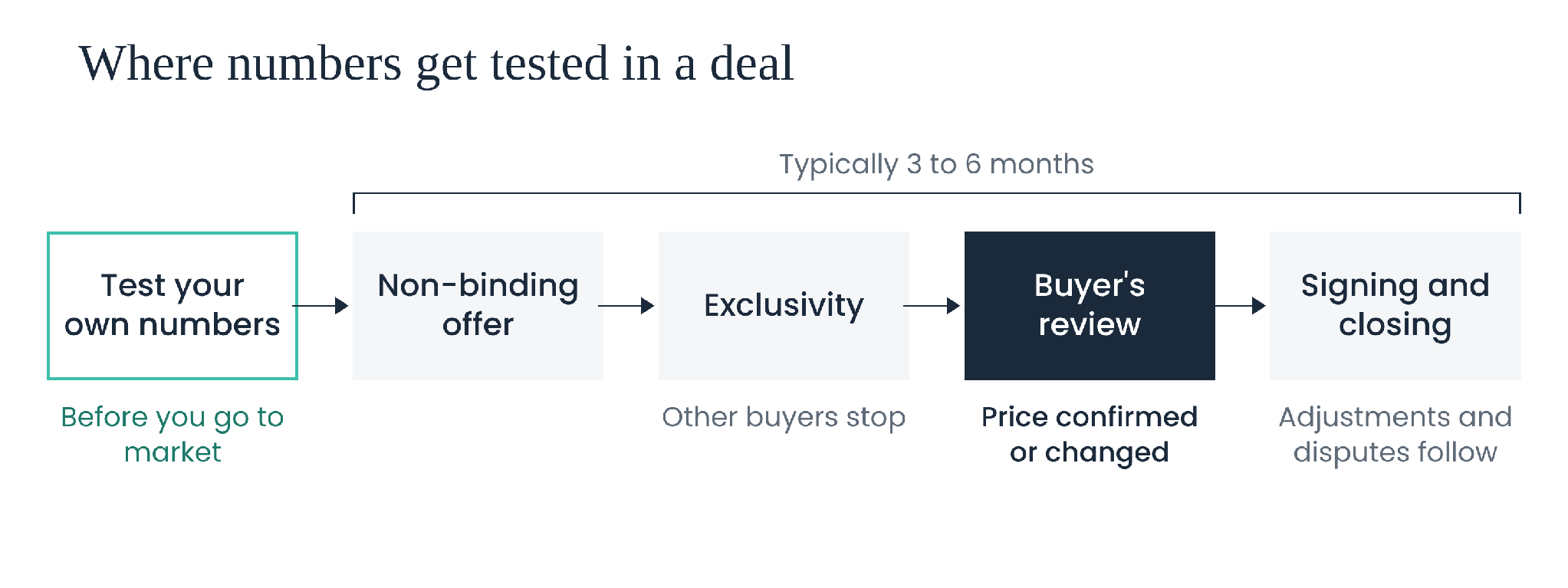
Exclusivity is common once a non-binding offer is signed,1 so by the time the buyer’s team opens your ledger you have stopped talking to other buyers and put real time and money into this one. The price in the offer is provisional, and this is the stage at which it gets confirmed or changed, which means a founder who has never tested the numbers hears the buyer’s opinion of them there.
A founder who has done the work first knows which adjustments can be supported and which can’t, so expectations are realistic before anyone else sets them and the buyer starts from the founder’s analysis. Some sellers commission a vendor review before going to market for this reason, and Brazilian law firms point to it as a way to avoid late price cuts and added escrows or indemnities.2 Disputes in Brazil mostly arise after closing, over price adjustments and indemnities,1 so numbers that were tested before signing leave less to argue about afterward.
What tends to weigh more in Brazil
In Brazil, a company’s tax and labor exposure stays with it when it is sold, so a buyer will price it in even if the company never recorded it. Tax authorities can look back five years, or six where fraud is alleged,3 and labor liabilities follow the business. A company with open tax assessments or unrecorded labor claims will see that bill return as a deduction from the price or as money held back at closing. Accounting rules make the number harder to read, because a company books a provision only when a loss is probable, while a buyer asks what the exposure could cost, and in an acquisition the standard itself requires the buyer to value contingent liabilities even when the loss is less than 50% likely,4 which is how the figure on your balance sheet ends up well below the one in the buyer’s model.
Founder-run companies bring a second set of adjustments, because the line between company and family can blur. A pro-labore well above or below what a hired executive would earn, personal costs paid through the company, rent paid to a shareholder’s property and sales to a sister company at prices no outsider would get each move of EBITDA, in one direction or the other. Informality is handled the same way, whether it is employees who aren’t on the payroll or revenue that never fully reached the books, and a buyer reads it as an earnings problem and as a liability.
If the company is taxed on presumed profit, tax is calculated on a presumed percentage of revenue rather than on accounting profit, so a buyer may have to build management numbers itself before it can test them. Whether revenue in the income statement matches the tax filings and the electronic invoices is the first check to run on any target, since a buyer will find any gap you haven’t explained.
With the Selic at 13.75% after the September cut, and bank credit above 25% a year not unusual,1,5 a company that funds itself by selling receivables early will get a question about recourse. With recourse, the cash received looks like debt, and the answer affects net debt and what counts as normal working capital in the contract.
ICMS and ISS rates start stepping down in 2029, ICMS incentives step down with them, and both taxes end in 2033,6 so a company whose margin depends on a state incentive should expect a buyer to ask what earnings look like as that benefit shrinks and to want its tax credit balances mapped and supported.
Before a process starts
If an exit is realistic in the next few years, the useful first step is building your own version of the buyer’s analysis, which means taking reported EBITDA, listing every adjustment you would propose, finding the document behind each one and checking that revenue matches across your accounts, your tax filings and your invoices. Your lawyers and tax advisers can size the tax and labor exposure so that you know the figure before a buyer names one, and owner pay, personal spending and related-party dealings belong on written terms. Most of it is worth doing whether or not you sell, because it shows you how the company is performing, and as a process gets closer a vendor review means the first outside look at your numbers is one you commissioned.
Frequently Asked Questions
Is my EBITDA times the market multiple a fair estimate of my price?
It is a fair place to start a conversation, though the price gets settled after the buyer has tested your earnings, working capital and debt, and in Brazil tax, labor and tax-reform items can move all three.
Do I need a quality of earnings review before I sell?
No, a vendor review is optional. The seller commissions it, from law firms, auditors or financial advisers, to surface issues before buyers do.2
Does a clean audit cover this?
It helps with the accounting, but a buyer will still test whether earnings continue under a new owner, and an audit does not do that.
What should a foreign buyer ask first?
Which books the numbers come from, since a Brazilian target can have statutory, management and tax versions of its results, and a reconciliation between them shows how much of the reported EBITDA a buyer can rely on. I would also scope the review together with tax and labor diligence and not after it.
Sources
- BVA Barreto Veiga Advogados. Corporate M&A 2026, Brazil: Law and Practice. Chambers Global Practice Guides (updated 21 April 2026). practiceguides.chambers.com ↗
- Machado Meyer. Corporate M&A 2026, Brazil: Trends and Developments. Chambers Global Practice Guides (2026). practiceguides.chambers.com ↗
- CMS. Tax dispute resolution: trends, tips and practical guidance, Brazil. cms.law ↗
- KPMG Brazil. Sinopse contábil e tributária 2017 (CPC 25, provisions and contingent liabilities); CPC 15 (R1), Business Combinations, items 22 to 23, as published by the CVM. assets.kpmg.com; conteudo.cvm.gov.br ↗
- Banco Central do Brasil, Copom decision of 16 September 2026, as reported by Jornal do Comércio (September 2026). jornaldocomercio.com ↗
- Emenda Constitucional 132/2023, ADCT arts. 128 and 129. planalto.gov.br ↗
Ilha Capital helps Brazilian business owners test their numbers before a sale process begins, not during one. If you are weighing an exit in the next one to three years, talk to us at contato@ilha.capital.