Joining Forces: Considering mid-market consolidation theses in Brazil
Why a consolidation thesis can be a credible path for mid-market companies facing expensive capital, and what a buyer should prepare first.
Necessity inspires creativity
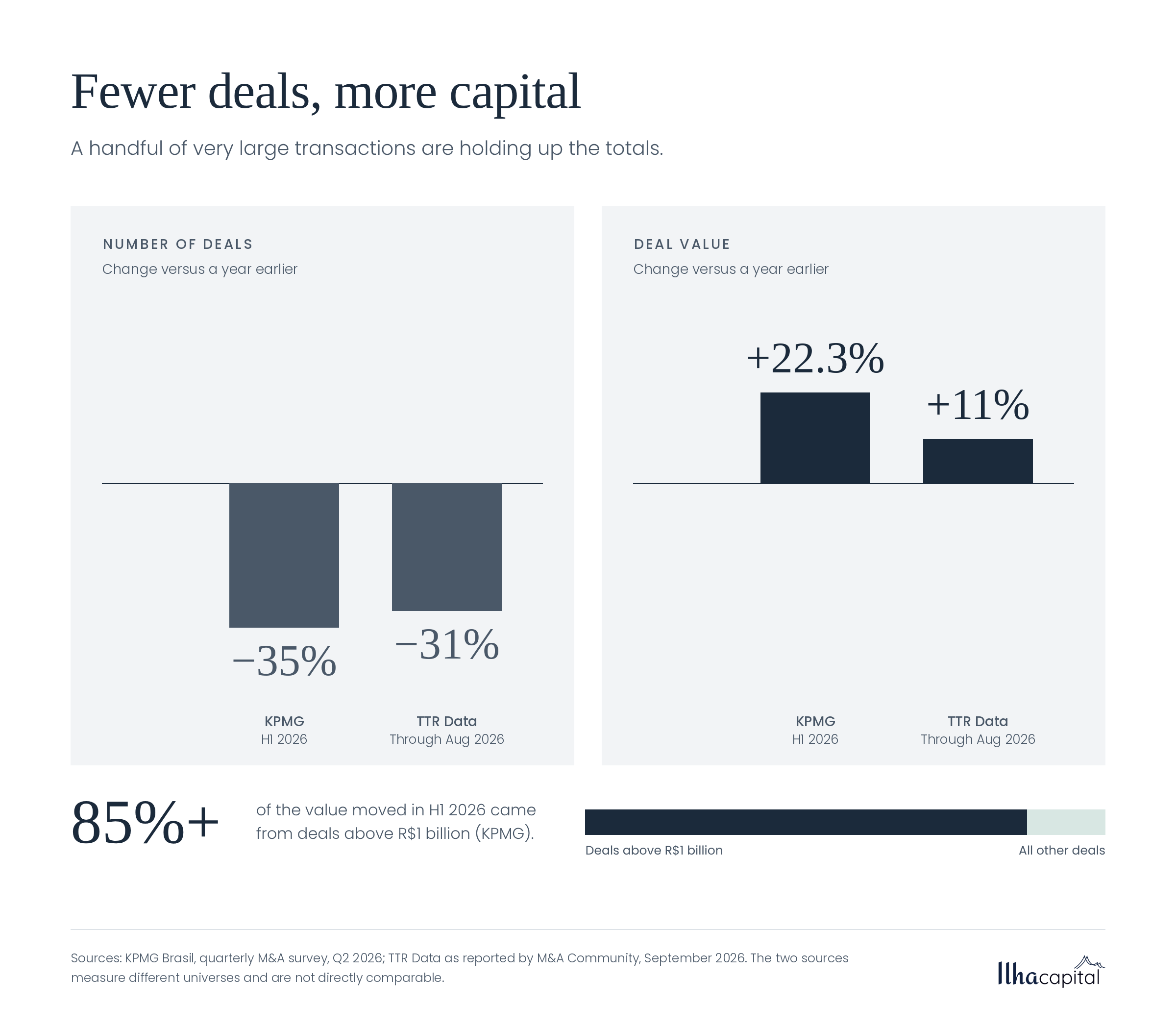
It is an interesting, and in many ways challenging, time for companies in the Brazilian mid-market. The cost of capital is high, has been high for a while, and will not fall drastically in the near future. Credit stays tied to those high base rates, investment from VC and PE funds is down, and the funds still investing are more selective. M&A volume is down as well, with a handful of very large deals holding up the totals: in the first half of 2026, KPMG counted 35% fewer transactions than a year earlier, while the value moved rose 22.3%, and more than 85% of it came from deals above R$1 billion.1 TTR data reported through August shows the same pattern, with 31% fewer deals and 11% more capital.2
Key Takeaways
- High capital costs encourage creativity. Funds are more selective, credit is expensive, and lower exit multiples often don’t make sense for companies with strong margins.
- Cash-light structures provide options. More mid-market companies are looking to mergers and priced equity participations to achieve strategic goals and scale.
- Buy-side preparation is often overlooked. A buyer’s own financials, operations and governance deserve the rigor a seller brings to an exit, especially when the other side takes equity.
What this means, in practice, is that there are a number of healthy and growing companies in the market that must now consider alternatives to their original strategies of either exiting within their target valuation range or going to the market to raise funds to support their next phase of growth.
People are responding with tools and strategies they might not have weighed a few years ago. Deal structures are more creative, more acquisitions are done in tranches, and a higher share of the value is tied to incentives and future performance, and law-firm commentary describes earn-outs and deferred consideration as increasingly common.3,4 I also see consolidation theses getting more attention, both from larger serial acquirers and from middle-market companies with very specific goals.
It makes sense (on paper)
Companies pursue consolidation theses for a number of different reasons. We’ve worked with clients looking to acquire companies to reach a certain size or market share, to meet the size thresholds that some large enterprise clients and certain investor profiles expect, or to broaden the client or product portfolio. Some theses are product-based, offering new products across the combined portfolio to cross-sell and upsell. Others rest on intellectual property or technology, or on buying a client portfolio to move into a new market where the cost of acquiring clients is high. For many companies, acquiring a product, a portfolio or a team makes more sense than trying to build or expand organically.
The digitization of traditional service industries has provided the base for tech-enabled acqui-hire theses, with a number of examples in the local market, such as the acquisition of accounting firms by platforms like BHub. In accounting, the buyer is purchasing a client portfolio and has a business model that needs accountants, whose relative costs come down as technology and scale make them more efficient. Tech-enabled businesses have historically exited at higher multiples than pure-play service businesses, so for the founder of the target, joining a tech-enabled consolidator can mean a more lucrative eventual exit. BHub has made ten acquisitions since November 2024, the latest being Agrocontar, described as the largest accounting firm in agribusiness.5
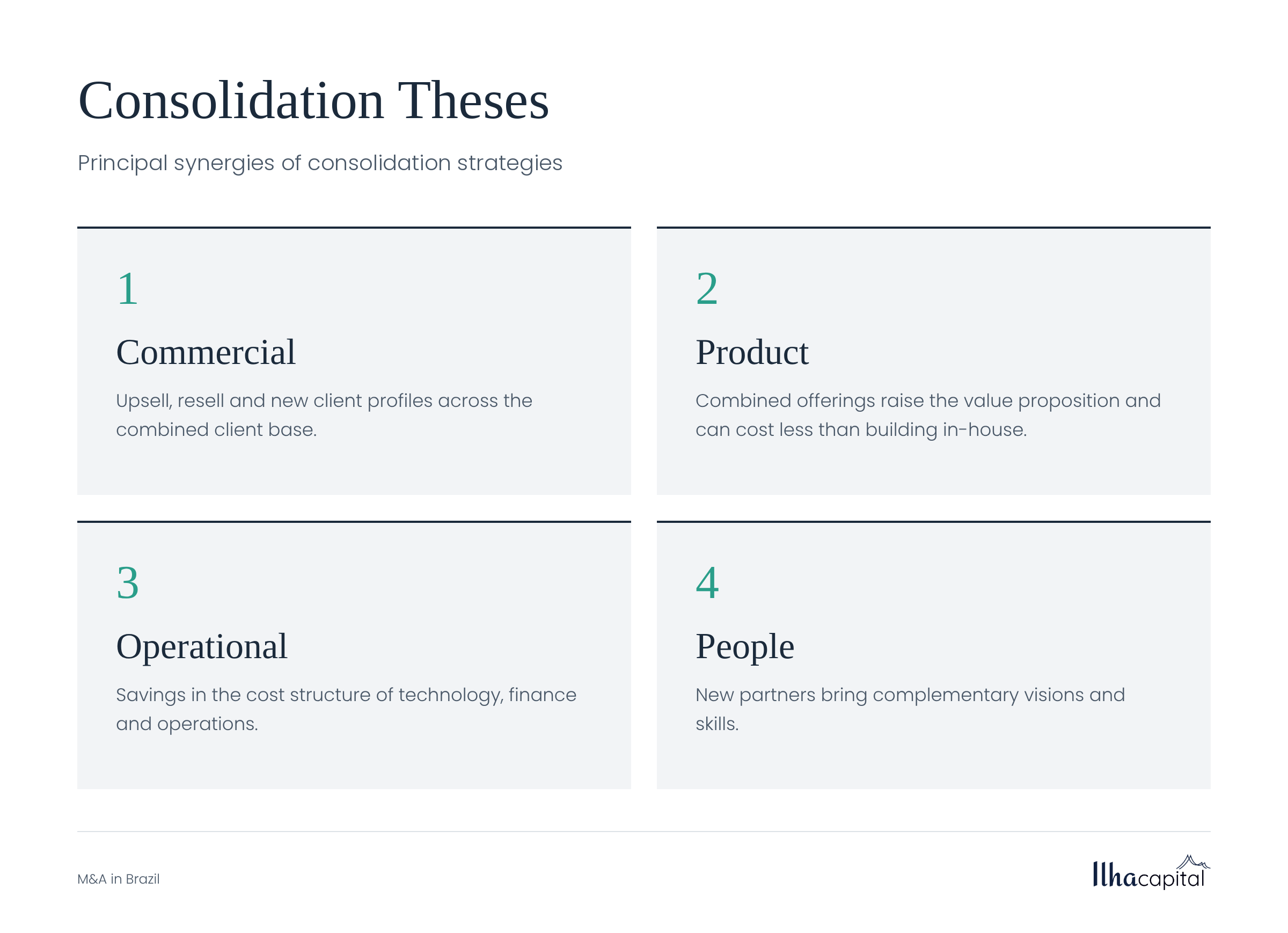
Finding another company with synergies on the relevant front, whether people, product, markets or client base, can be a viable option, especially when its leadership and shareholders share the vision and are open to a structure that is short on cash. That can be a priced equity participation, a true merger that forms a new entity, or a new partnership structure within one entity. The synergies tend to show up in four places: commercial, through upsell, resell and new client profiles; product, where combining offerings can raise the value proposition and cost less than building in-house; operational, through the cost structure in technology, finance and operations; and expertise and people, as new partners bring complementary visions and skills. For the founder of the target company, it can be a chance to continue the growth journey with a new vision and new resources. In these structures the other side stays involved after closing, which makes preparation matter even more.
Considerations for a successful union
There is a lot of discussion about how to prepare a company for a sale, and rightly so. No one wants to be caught off guard when negotiating an exit, and a number of solid governance practices can have a large impact on price and value. Many people who see the value in the structures above have not thought about preparation the same way on the buy-side.
One thing that can be overlooked is an internal financial and operational audit before buying. It rarely feels urgent, but I consider it highly advisable. A new company always brings additional demands, and the process itself is always some distraction from core operations, so the more buttoned up the buyer’s own governance is, the better position the company will be in to realize the synergies it modeled.
A formalized thesis is another part of buy-side preparation, and I think discipline in sticking to one is among the things that have allowed serial consolidators, vertical market software buyers among them, to be so successful. Criteria that are written down and signed by all relevant stakeholders make it easier to say no to a deal that is attractive but does not fit. Relationships with the owners of companies one might someday buy take time to build as well, and they put a buyer in a better position when a deal becomes possible.
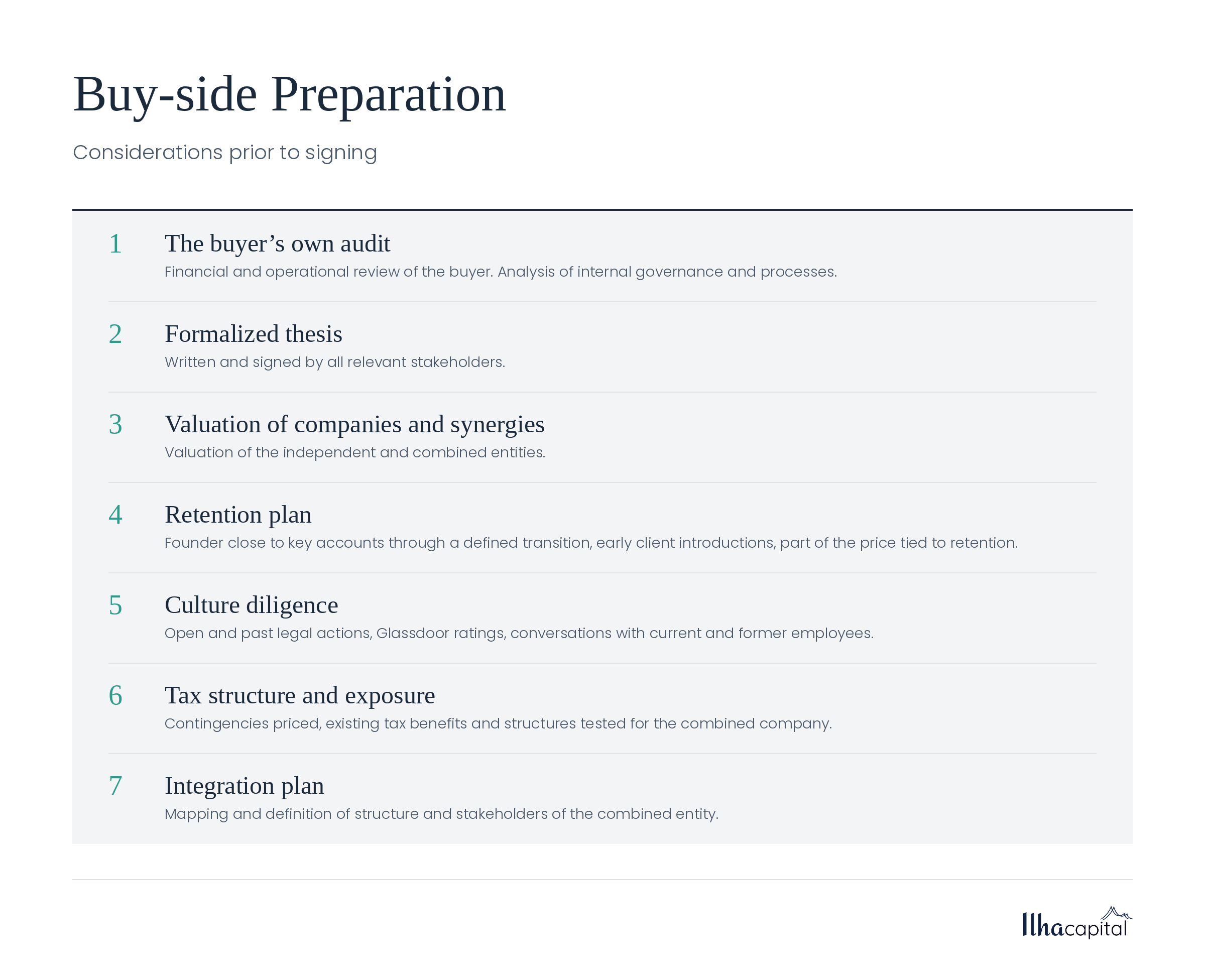
In structures short on cash, the other side is also taking the buyer’s equity, so it will examine the buyer’s numbers as closely as the buyer examines theirs, and the valuation of the two companies as independent entities and as a combined one, including the synergies, needs to be settled in the first conversation. Tranches and incentive-based value are ways to bridge a valuation gap.
People, culture and client relationships are essential pieces of successful companies, and deserve formal analysis and criteria when considering a deal. In Brazil, business relationships are often personal and built over years, usually with the founder, and that trust does not move to a new owner on its own. Because those relationships are part of the value the buyer is paying for, a retention plan can include keeping the founder close to key accounts through a defined transition, introducing the new owner to clients early, and tying part of the price to retention rather than to financial results alone.
Almost every company says culture is important, but a weak one can weigh heavily on whether the synergies from a deal are ever realized. Reviewing open and past legal actions is a good place to start.6 Culture indicators such as Glassdoor ratings can help, as can direct conversations with current and former employees.
Tax diligence covers two questions. The first is exposure: a contingency that is known and quantified can be priced into a deal, while one found after closing cannot. The second is structure. Many Brazilian companies have built a tax structure around their operations, through their tax regime, entity layout and any sector or regional incentives, and a combination can change whether those arrangements still apply. A buyer is better placed if it analyzes, before signing, whether the combined company will keep its benefits and operate efficiently within the existing structures, or whether a new structure is needed, in which case that structure has to be examined, modeled and priced. The tax reform adds to this, since a target’s credit chains, contracts and pricing will move to the new consumption-tax model and case law is not yet settled,7 so the assumptions behind a valuation are worth writing down.
Acquirers that put an owner, a timeline and funding behind every value initiative before integration begins appear more likely to deliver what they set out to achieve. In PwC’s 2026 integration survey of large companies, only about one in three acquirers fully achieved all of their prioritized deal objectives, and the successful ones were about twice as likely to have had that planning in place beforehand.8 A plan of that kind should also map and define, before signing, the structure and stakeholders of the combined entity, including who leads, who stays and which systems it will run on.
For healthy and growing companies weighing alternatives to a sale or a capital raise, a consolidation thesis is a credible path to growth, and preparing for the buy-side with the same rigor founders bring to preparing for an exit is what puts a company in a position to realize the synergies behind the deal.
Frequently Asked Questions
Why are Brazilian mid-market companies considering consolidation?
With capital expensive and funds more selective, exits at lower multiples often make little sense for companies with strong margins. Mergers and priced equity participations let them pursue scale and strategic goals with little cash, which is why consolidation theses are getting more attention.
Where do the synergies of a consolidation show up?
In four places: commercial, through upsell, resell and new client profiles; product, where combined offerings can cost less than building in-house; operational, through the cost structure in technology, finance and operations; and expertise and people, as new partners bring complementary visions and skills.
What should a buyer prepare before a deal in which the other side takes equity?
An internal financial and operational audit, a written thesis signed by the relevant stakeholders, and a valuation of both companies, alone and combined, settled in the first conversation. The other side examines the buyer's numbers as closely as the buyer examines theirs.
How can a buyer protect founder and client relationships in Brazil?
Business relationships there are often personal and built over years with the founder, and that trust does not move to a new owner on its own. A retention plan can keep the founder close to key accounts through a defined transition, introduce the new owner to clients early, and tie part of the price to retention rather than to financial results alone.
Sources
- KPMG Brasil, Pesquisa trimestral de M&A, 2º trimestre de 2026. kpmg.com ↗
- M&A Community, M&A Brasil 2026: transações, capital e governança familiar (22 September 2026; TTR Data through August 2026). mnacommunity.com ↗
- Chambers Global Practice Guides, Corporate M&A 2026, Brazil: Trends and Developments. chambers.com ↗
- Capital Aberto, Gap de valuation muda negociações de M&A (8 October 2026). capitalaberto.com.br ↗
- Brazil Journal, BHub compra o maior escritório de contabilidade do agro (26 November 2025). braziljournal.com ↗
- Capital Aberto, M&A mais seletivo aumenta o preço da desorganização jurídica (28 October 2026). capitalaberto.com.br ↗
- Capital Aberto, Reforma tributária leva M&A a olhar além do passivo fiscal (21 July 2026). capitalaberto.com.br ↗
- PwC, 2026 M&A Integration Survey (29 September 2026). pwc.com ↗
Ilha Capital advises on buy-side M&A in Brazil. If you are weighing an acquisition or a merger, talk to us at contato@ilha.capital.
This article is also published as a LinkedIn newsletter edition: read it on LinkedIn ↗